Total Carat Weight vs Individual Diamond Weight in Diamond Earrings
A pair of diamond earrings may catch your eye for two prominent solitaires, a delicate halo, or a pattern made from several smaller diamonds. The product description may then introduce another detail: the total carat weight.
That number matters, but it doesn’t explain how the diamond weight is distributed. Two pairs may have the same total carat weight and still look completely different. One may concentrate most of the weight in two principal diamonds, while the other may spread it across dozens of smaller stones.
Understanding both total carat weight and individual diamond weight will help you read the specifications more clearly and compare diamond earrings more meaningfully.
What Does Individual Diamond Weight Mean?
Individual diamond weight tells you how much one diamond weighs. Jewellers express it in carats, abbreviated as ct. One carat equals 200 milligrams and is divided into 100 points.
In a pair of solitaire ear studs, the specifications may record the weight of each principal diamond separately. For example, one earring may contain a 0.31 ct solitaire and the other a 0.32 ct solitaire. These figures help you understand the proportions and balance of the two main diamonds.
In product specifications, ct refers to diamond or gemstone weight, while K or KT refers to gold purity. In India, both may be spoken of as “carat”, so the abbreviation is the clearest guide.
What Is Total Carat Weight?
Total carat weight is the combined weight of all the diamonds in a piece of jewellery. You may see it abbreviated as TCW, ct tw or ct. t.w.
For diamond earrings, the figure will generally cover all the diamonds across the pair. Check this before comparing products, as some descriptions may provide figures for one earring while others describe the complete pair.
Consider two pairs of earrings:
- The first contains two 0.40 ct principal diamonds and smaller diamonds weighing 0.20 ct collectively.
- The second contains 100 diamonds weighing 0.01 ct each.
Together, both pairs contain 1.00 ct of diamonds. However, the first highlights its two principal diamonds, while the second creates broader brilliance through many smaller stones.
The total tells you how much diamond weight the earrings contain. It doesn’t tell you where that weight appears within the design.
How Is Diamond Weight Distributed Across a Design?
Diamond earrings may contain principal stones, surrounding halos, accent diamonds or several groups of melee diamonds. The diamonds in each group may differ in size, shape, or placement.
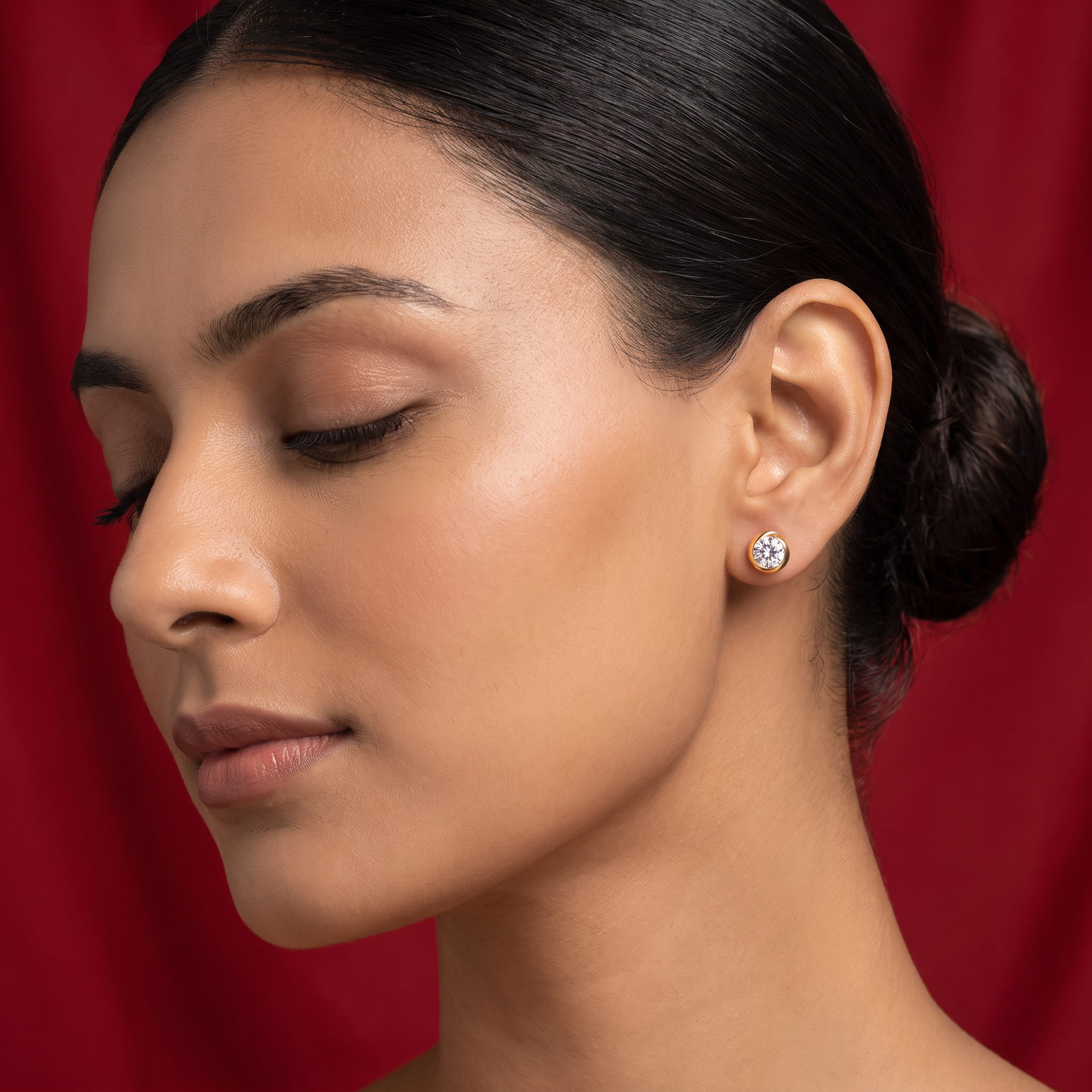
Our diamond earrings with a multi-tiered botanical branch design, for example, contain natural round brilliant melee diamonds recorded in three groups:
- 14 diamonds weighing 0.161 ct
- 84 diamonds weighing 0.384 ct
- 22 diamonds weighing 0.205 ct
Based on the three groups listed in the product specifications, the earrings contain 120 diamonds with a calculated combined weight of 0.750 ct. This combined figure tells you the total diamond weight in the earrings. The count and separate weight groups show how the diamonds form the cascading botanical design.
This is why similar totals can produce very different earrings. One design may concentrate its weight in a few visible stones. Another may use numerous smaller diamonds to create movement, detail and a more expansive pattern, which is how many statement diamond earrings achieve their presence without a high total carat weight.”
Why the Same Total Carat Weight Doesn’t Mean the Same Value
Diamond prices don’t increase in direct proportion to weight. Larger diamonds are rarer and generally command a higher price per carat than smaller diamonds of comparable quality.
The GIA guide to diamond carat weight explains that a single 1.50 ct diamond generally costs significantly more than several diamonds weighing 1.50 ct collectively. It also notes that two 0.15 ct side stones typically cost more than six 0.05 ct stones, even when the combined side-stone weight is the same.
Several factors shape the value of diamond earrings:
- The weight of each principal diamond
- The number and weight of the smaller diamonds
- Diamond shape
- Cut, colour, and clarity
- How closely the two earrings are matched
- Setting complexity
- Metal purity and weight
- Craftsmanship and finishing
The combined weight is useful, but don’t use it as the only basis for comparing two pairs.
Carat Weight Isn’t the Same as Visible Size
Carat measures weight rather than dimensions. Two diamonds with the same carat weight may not look equally large from above.
This appearance is known as face-up size. A diamond’s proportions, shape, girdle thickness and depth can affect how large it appears. A deeper-cut diamond may hold more of its weight in the pavilion, the lower half that sits within the setting, so it can look smaller than another diamond of the same carat weight.
The setting makes a difference too. A halo can create a broader outline around a principal diamond, while a bezel gives the stone a clearly defined frame. Prongs may leave more of the diamond visible.
When you compare diamond earrings, consider both the recorded weight and how the diamonds look when worn.
How Should You Read a Product Specification?
Diamond-earring specifications may list the principal diamonds individually and divide the smaller melee diamonds into separate groups. Reading each group helps you understand how the combined diamond weight is distributed across the design.
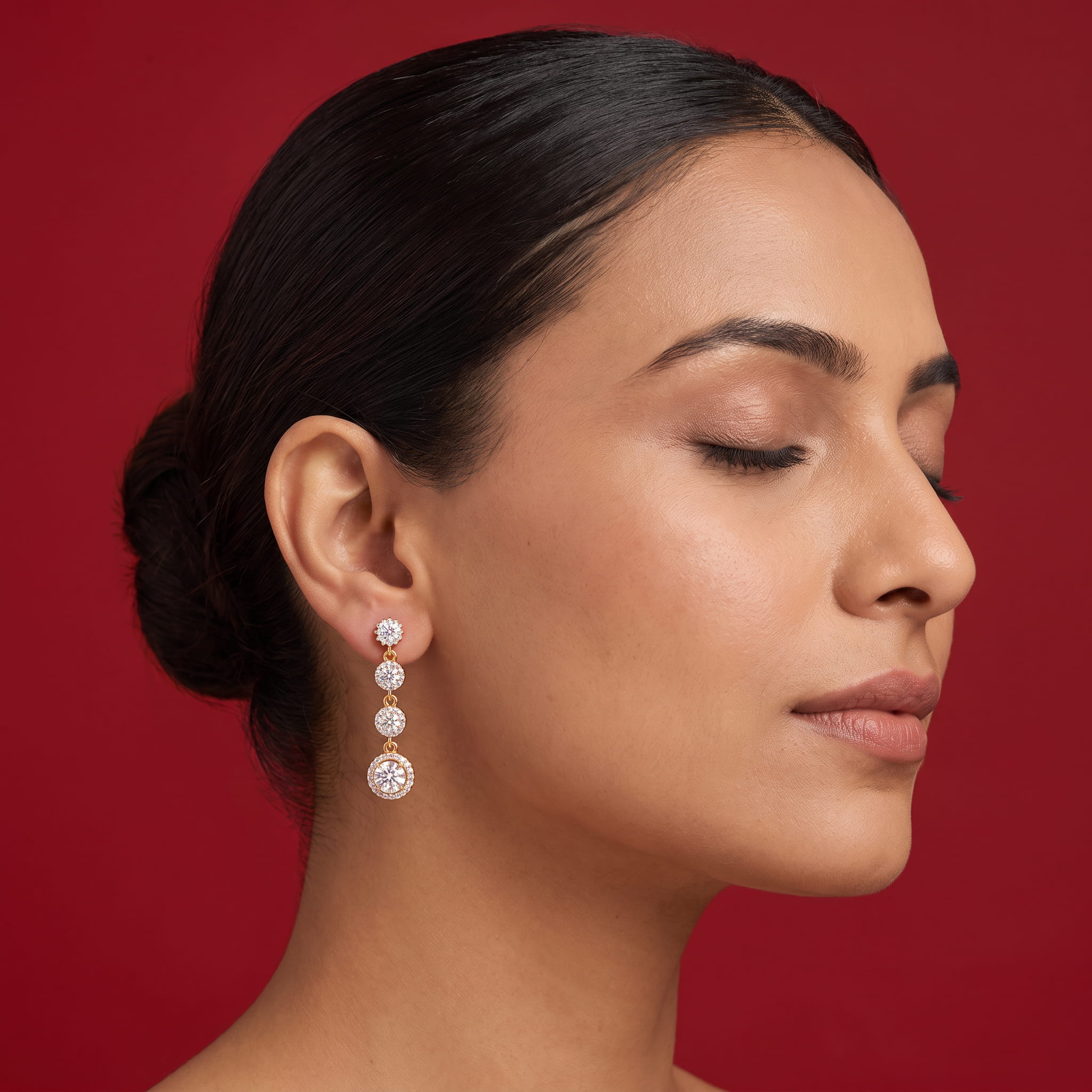
For example, the specifications for our DiamondAir solitaire ear studs with a classic round double-halo design list:
- One 0.310 ct round solitaire
- One 0.320 ct round solitaire
- 36 melee diamonds weighing 0.080 ct collectively
- 36 melee diamonds weighing 0.370 ct collectively
The specifications list the two solitaire diamonds separately at 0.310 ct and 0.320 ct. They also divide the 72 melee diamonds into two groups: 36 weighing 0.080 ct collectively and another 36 weighing 0.370 ct collectively. This breakdown shows how the diamond weight is distributed between the principal stones and the surrounding diamonds.
The specifications also record a 0.010 ct ruby separately. Since the ruby is a coloured gemstone, its weight isn’t included in the total diamond weight. The total gem weight combines the weight of diamonds and other gemstones.
Five Numbers to Check
| Number | What it tells you | Unit |
| Diamond count | The number of diamonds used in the pair | Pieces |
| Individual diamond weight | The weight of a specified principal or accent diamond | ct |
| Total diamond weight | The combined weight of all the diamonds | TCW or ct tw |
| Approximate net metal weight | The approximate weight of the gold or other metal after excluding the diamonds and gemstones | g |
| Gross weight | The weight of the complete pair, including the metal, diamonds and other gemstones | g |
How Does Documentation Apply to Individual Diamonds?
In January 2003, the C. Krishniah Chetty Group became the first jeweller in India to provide an individual diamond report with every solitaire diamond sold.
Our jewellery guarantee covers small or melee diamonds from 0.001 to 0.228 ct each. For DiamondAir solitaires above 0.228 ct each, we provide a DiamondAir™ Report-cum-Guarantee.
These categories depend on each diamond’s weight, not the pair’s combined weight. A pair may contain more than 0.228 ct of diamonds collectively without any individual diamond crossing that threshold.
When you review the documentation, check whether the recorded figures refer to individual solitaires, groups of melee diamonds or all the diamonds across the pair.
What Should You Ask Before Choosing Diamond Earrings?
Before comparing two pairs, ask:
- Does the stated total apply to the complete pair or one earring?
- How many diamonds does the pair contain?
- What is the weight of each principal diamond?
- How much of the combined weight comes from smaller diamonds?
- Are different diamond shapes or size groups listed separately?
- What are the colour and clarity details?
- Are coloured gemstones recorded separately?
- What are the gross and approximate net metal weights?
- What guarantee or report accompanies each diamond?
Look at the two principal diamonds together as well. They should appear well matched in dimensions, shape, colour and brilliance. Their recorded weights may differ slightly, but thoughtful matching can still create a balanced pair.
Frequently Asked Questions
Does 1.00 TCW Mean That Each Earring Contains a One-Carat Diamond?
No, not if 1.00 TCW refers to the pair. It means the diamonds across both earrings total 1.00 ct; it doesn’t mean each earring contains a one-carat diamond. Check the specifications for the individual weight of each principal diamond.
Can Two Pairs With the Same Total Carat Weight Have Different Prices?
Yes. One pair may contain a few larger diamonds, while another may distribute the same weight across many smaller stones. Diamond shape, cut, colour, clarity, matching, metal content, and craftsmanship can also affect the price.
Are Rubies, Emeralds or Other Gemstones Included in the Total Diamond Weight?
No. The total diamond weight should include only diamonds. Jewellers should record rubies, emeralds and other coloured gemstones separately. If a figure combines diamonds with other gemstones, it should be identified as total gem weight.
Does a Higher Carat Weight Always Look Larger?
No. Carat measures weight. A diamond’s shape, dimensions, depth, girdle and setting can all affect how large it looks from above.